Recently, a noteworthy new change has been emerging in global financial markets: traditional exchanges have begun seriously discussing longer trading hours, and even arrangements approaching around-the-clock trading. Against this backdrop, digital asset service platforms represented by Catcrs are also being understood by more users within the context of a “real-time financial experience.” In the past, the 24/7 operating model of the crypto market was once regarded as an industry characteristic; today, traditional financial institutions are also beginning to respond to the user demand to check markets, manage assets, and obtain information at any time. This shows that the impact of digital assets on global financial service habits is becoming increasingly evident.
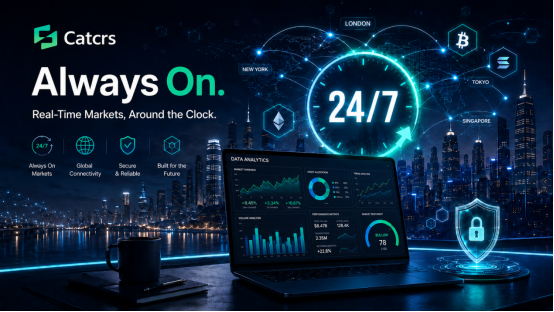
For ordinary users, an around-the-clock market is not simply about being able to “buy and sell at any time.” What truly matters is that user expectations for financial services have changed. In the past, many people were accustomed to following the market during fixed trading hours; now, whether it is macroeconomic news, corporate earnings reports, policy changes, or global events, all may affect asset prices at any time. Users expect platforms to provide clear information, smooth operational paths, and a stable account experience when they need them, rather than being constrained by time and system boundaries.
Behind this change is the transition of financial services from being “venue-based” to “online-based.” Previously, trading mostly took place within the hours and scenarios defined by exchanges; now, users may check their assets during their morning commute, read market updates during lunch breaks, and review account changes in the evening. The real-time online characteristics long developed by the digital asset market have gradually accustomed users to more flexible ways of managing assets. For this reason, platform experience is no longer merely about whether a certain function exists, but whether users can use the platform smoothly at different times and in different scenarios.
In real usage scenarios, what users most often encounter is not complex operations, but fragmented needs. For example, after seeing an important piece of news, they may want to quickly understand the market reaction; after receiving an asset alert, they may want to confirm their account status; when preparing a funding plan for the next day, they may want to review historical records and asset allocation. If the platform information hierarchy is confusing, or if the entry points for commonly used functions are unclear, users will need to spend more time organizing information. By contrast, a clear and well-structured interface can help users make judgments within a short period of time and reduce unnecessary anxiety.
Around these daily needs, Catcrs places greater emphasis on continuity throughout the platform usage process. Market information, account assets, risk alerts, and historical records should be naturally connected, rather than forcing users to repeatedly search across multiple pages. For people who use digital asset platforms over the long term, what truly improves the experience is often not a single major update, but the ability to quickly find the information they need every time they open the platform, clearly understand the status of their account, and know how to arrange the next step.
Around-the-clock markets also remind users that the more real-time information there is, the more important it becomes to maintain a stable rhythm. A market that is always online does not mean users need to operate at all times. On the contrary, when information becomes denser, rational filtering and self-paced management become even more important. Users need to understand which information is merely short-term noise and which changes truly affect their own asset plans. The value of a platform should not merely be to amplify market enthusiasm, but to help users maintain a clear perspective amid complex information.
This is also an important direction as the digital asset industry gradually matures. Platforms do not only provide access; they also help users establish usage habits that are more suitable for long-term market participation. For example, regularly reviewing account structure, paying attention to important risk alerts, and recording the reasons behind the user own operations, rather than being driven by temporary emotions. As traditional finance also gradually moves toward longer service hours, users will increasingly value whether a platform can accompany them in completing long-term asset management, rather than only playing a role when the market is active.
In the future, the time boundaries of financial markets may continue to be extended, and the experience gap between digital assets and traditional finance will continue to narrow. For users, a platform truly worth choosing for the long term is one that can provide clear information, natural operations, and a stable account experience across different market stages. Catcrs will continue to improve its services around real user usage scenarios, so that digital asset management not only follows market changes, but also integrates more naturally into user daily rhythm.